

Do you need a water filtration system in Melbourne?
Not for safety. Melbourne’s supply is treated and disinfected before it reaches you, so the real question is whether chlorine, sediment, or taste and odour bother you at more than one tap. If they do, a whole home system is the only option built to reach all of them.
What actually changes once it is in?
Every tap in the house runs through one system, so the difference turns up wherever you use water rather than only at the kitchen sink.
In the drinking glass
The chlorine tang comes out of drinking water at every tap, not just the one you fitted a filter to.
In the shower
The pool smell that comes up in the steam is the thing most households notice first, and the reason they say the water feels softer to shower in.
In the kettle and the coffee
Tea, coffee and stock all taste of the water they are made with. Take the chlorine out and what is left is the ingredient.
In the laundry and the fixtures
Sediment is caught at the main, before it reaches a washing machine, a mixer cartridge or a shower rose.
Chlorine bothers you at more than one tap, you own the place, and you are staying. One install fixes every tap at once, permanently.
If it is only the drinking water at the kitchen sink, a jug or an under sink unit settles it. If the taste follows you past the kitchen, only a whole home system reaches every tap.
If you rent, or if nothing about the water actually bothers you.
What is actually in Melbourne’s tap water?
Eight measures were tested and published across 2024 to 2025. Seven are unremarkable. One changed.
| Measure | Reported | Reference point |
|---|---|---|
| E. coli | Zero in 13,577 samples | Any detection is a failure |
| PFAS | Not detected | Detection limit 0.002 µg/L |
| Chlorine | 0.76 mg/L average | Guideline 5 mg/L, added as the disinfectant |
| Hardness | 18 mg/L, range 15 to 27 | 200 mg/L, where scale becomes an issue |
| Fluoride | 0.81 mg/L | Added under state policy, not by the retailer |
| pH | 7.4 | Neutral is 7.0 |
| Turbidity | 0.8 NTU, 95th percentile | Standard 5.0 NTU |
| Taste and odour complaints | Up 22% to 276 | Attributed to increased chlorine residuals |
What does a whole home system actually do?
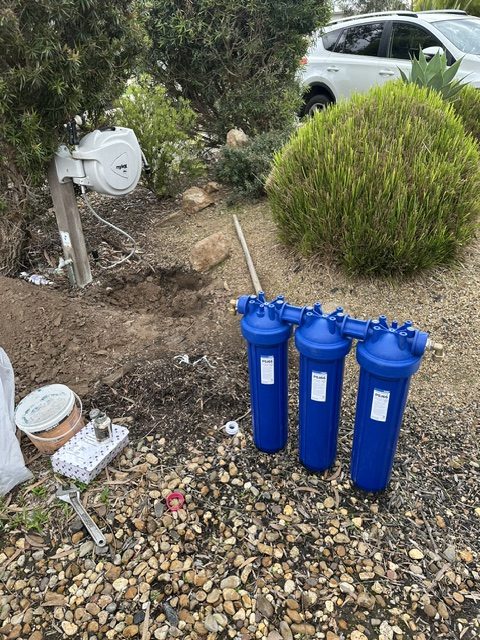
Three things, at every tap in the house rather than one, because it is fitted where the water main enters the property.
Sediment. Fine particulate picked up in the mains, usually turning up after a burst or street works.
Chlorine. The disinfectant that keeps the supply safe on the way to you. Reducing it changes how the water tastes, not whether it is safe.
Taste and odour. In the shower and the kettle as well as the kitchen tap. This is the one people actually buy for.
And what it does not do
Not a fluoride treatment
Not a PFAS treatment
Not a softener
It does not make safe water safer. If a claim beyond sediment, chlorine, and taste and odour is made to you about any cartridge system, ask which certification supports it.
What are the options, and what do they cost?
Four, from a thirty dollar jug to the one system that treats every tap in the house. Which one is right depends on how far the problem reaches, not on the sticker.
| Option | Cost | What it covers, and who can fit it |
|---|---|---|
| Filter jug | $30 to $60 |
Drinking water only. Nothing plumbed in, nothing left behind when you move. Right if you rent |
| Under sink | $300 to $900 |
One point, usually the kitchen. Does not reach the shower, the bath or the laundry. Covers one tap only |
| DIY mains kit | $500 to $800 |
Equipment for the main, sold to be fitted by the buyer. In Victoria a homeowner may not do this work, and no certificate can be issued for it. Not legal for you to install |
| Whole home, installed | $2,999 ours $3,190 published locally |
Fitted at the main, so every fixture in the house runs through it. Licensed plumbing work, with a certificate of compliance. Right if you own it and intend to stay |
Which one is right for your situation?
Open the one that sounds like you. Three of the seven end with us telling you to buy nothing at all.
Renting I rent, and the water tastes off
A whole home system is plumbed into the property’s main, needs the owner’s written approval, and stays with the house when you leave. It is the wrong purchase for a tenancy.
A jug handles drinking water and goes with you. If the taste in the shower is the problem rather than the taste in the glass, that is a conversation with the owner, not a purchase you should be making.
Drinking water only It is just the water in the glass
If the chlorine taste only registers when you drink it, treating the whole house is treating six or seven fixtures you were never going to notice.
An under sink unit handles that one tap for a fraction of the cost. Before you settle on it, check where else the water follows you: if the chlorine is in the shower steam and the kettle as well as the glass, one tap was never the whole problem, and a whole home system is the only option built to reach every outlet at once.
The most common one Why does the water taste and smell of chlorine?
Because chlorine is added at the treatment plant to keep the supply safe, and it stays in the water all the way to your tap. It is the single most common reason Melbourne households look at filtration, and it has become more noticeable here: residuals were deliberately raised across this network, and taste and odour complaints rose 22% in a year.
If you notice it in the glass, you will meet it again in the shower steam, the kettle and the laundry, and an under sink unit reaches none of those. This is the household a whole home system exists for.
New build We have just moved into a new house
Live in it through a full season first. New estates often see grit and cloudy water in the early months while mains work continues nearby, and that usually settles on its own.
If it has not settled after a few months, or the chlorine is the thing you keep noticing, then it is worth pricing. A new build is the easiest install we do, so waiting costs you nothing.
Sediment The water went cloudy after works in the street
Discoloured water after a burst or street works is usually disturbed sediment in the main, and it normally clears within a day. Report it to South East Water before you spend anything, because it may not be your problem to fix.
It is not a rare complaint here. Discoloured water complaints across the network rose 43% in 2024 to 2025, driven by mains repairs in Cranbourne and a manganese episode that reached suburbs including Clyde North, Berwick, Officer and Pakenham. If it keeps happening on your street, a whole home system is the option that catches sediment before it reaches any fixture.
Hard water Someone told me we have hard water
Hardness on this network averages 18 mg/L, against the 200 mg/L point where scale becomes an issue. At roughly a tenth of that, there is close to nothing here to soften.
Scale treatment sells hard in this category and solves a problem Melbourne does not have. Ask whoever told you what reading they measured at your property, then apply the same test to us. We do not sell softeners and we would not fit one here.
Selling or moving We might sell in the next year or two
A whole home system stays with the house, and it presents as what it is: a certified plumbing upgrade that makes the water taste and feel better at every tap a buyer turns on. The compliance certificate transfers with the property, so the next owner inherits the paperwork as well as the water.
You get the benefit for every day you are still there, and a genuine point of difference when you list. If you would rather spend as little as possible before moving, an under sink unit covers the kitchen in the meantime.
Why do the quotes vary so much?
Because the low figures are equipment prices and the high ones are installed prices, and they are almost never presented as different things.
| What you are actually buying | Equipment only$500 to $800 | Installed$2,999 with us |
|---|---|---|
| The unit itself | Included | Included |
| A manufacturer’s warranty | Included | Included |
| A licensed plumber, the only person permitted to do the work | Not included | Included |
| Sizing against the pressure and flow at your main | Not included | Included |
| A bypass, so the water stays on at every cartridge change | Not included | Included |
| An enclosure, testing and handover | Not included | Included |
| A certificate of compliance in your name | Not included | Included |
| Someone to call if it leaks in two years | Not included | Included |
The cheapest figure does the damage, because it is what comes back from a search and it sets the expectation. It is a real price for a real object. It is not a price for the same thing. See ours line by line.
Who can legally install one in Victoria?
A licensed plumber. Work on a property’s drinking water supply is licensed plumbing work, regulated by the Building and Plumbing Commission, which replaced the Victorian Building Authority on 1 July 2025.
Over $750
A certificate of compliance is required
Issued to you within five days of completion, lodged with the regulator within five days, and it cannot be withheld over an unpaid invoice. How the certificate works.
AS/NZS 3497 against NSF/ANSI
WaterMark is not a performance test
It certifies that a product is legal to connect to mains supply. What a filter actually reduces is tested under NSF/ANSI 42 and 53. WaterMark against NSF.
Nine questions to ask any installer
Are you a licensed plumber, and what is your licence number?
A number you can check on the public register. Ours is 50783.
Will you issue a certificate of compliance, and when?
Within five days of completion, lodged within five days. Hesitation here is the whole story.
Who carries out the work, you or a subcontractor?
If it is a subcontractor, their name goes on the certificate. Ask for their licence too.
What does the system reduce, and what document states it?
Ask for the manufacturer’s stated scope in writing, then compare it with the sales pitch.
Is it certified to NSF/ANSI 42 or 53, or only to WaterMark?
WaterMark is plumbing. NSF/ANSI is performance. A large claim needs the second one.
What hardness reading is any scale claim based on?
Compare the answer with 18 mg/L. If nobody measured, the claim is not about your property.
Where will it be fitted, and is a bypass included?
Without a bypass the water shuts off at every cartridge change.
What do replacement cartridges cost, and how often?
At least every 12 months. Get the price at the quote, not at the first change.
Is the price fixed in writing, and what is excluded?
An estimate that moves once the work starts is not a price.
The five questions this page has not already answered
Does a whole home water filter remove fluoride?
No. The system we install is not sold as a fluoride treatment, and its stated scope is sediment, chlorine, and taste and odour.
Fluoride is added under state health policy rather than by the water retailer, at an average of 0.81 mg/L. Anyone telling you a whole home cartridge system removes it should be asked which certification says so.
Is there PFAS in Melbourne’s drinking water?
South East Water reported PFAS as not detected in 2024 to 2025, at a detection limit of 0.002 micrograms per litre.
Testing was carried out by ALS Group, an independent NATA-accredited laboratory. PFAS is not something a filtration system on this network is solving, because there is nothing reported to solve.
Will a whole home filter reduce my water pressure?
Not if it is sized for your property.
The system is selected against the pressure and flow at your water main, which is one of the things a licensed plumber checks before fitting it. A system sized for a different house is where pressure complaints come from.
How often do the cartridges need replacing?
At least every 12 months. They are the only ongoing cost, and they are not included in an installed price.
Ask for the cartridge price at the quote rather than at the first change, and ask whether a bypass is fitted, because without one the water shuts off every time they are swapped.
Can I install one myself in Victoria?
No. A homeowner cannot lawfully work on the property’s drinking water supply.
No certificate of compliance can be issued for work done that way, which can matter for insurance and at sale. It is the reason the DIY mains kit above is cheaper.
One system, fitted where the water enters the house
A BWT whole home system, plumbed in at your water main by a licensed Victorian plumber, so every tap in the house runs through it from the day it goes in.
It starts with a free in-home water consultation. Then one day on site. A bypass fitted at the same time, so the water stays on at every future cartridge change. A certificate of compliance issued in your name, by the same business that did the work. One price, quoted before we start, that does not move once it has.
Not the right purchase if you rent. It is plumbed into the property’s main, it needs the owner’s approval, and it stays with the house when you go. Buy a jug instead and take it with you.
- In-home consultation
- Free
- Price, fully installed
- $2,999
- GST
- Included
- Certificate of compliance
- Included
- Time on site
- One day
- Fitted at
- The water main
- Taps covered
- All of them
- Cartridges
- Yearly, extra
- Plumbing licence
- 50783
Ready to talk it through?
Book a free in-home consultation. We look at your water and your plumbing and tell you what would make a difference, including when the answer is nothing.